
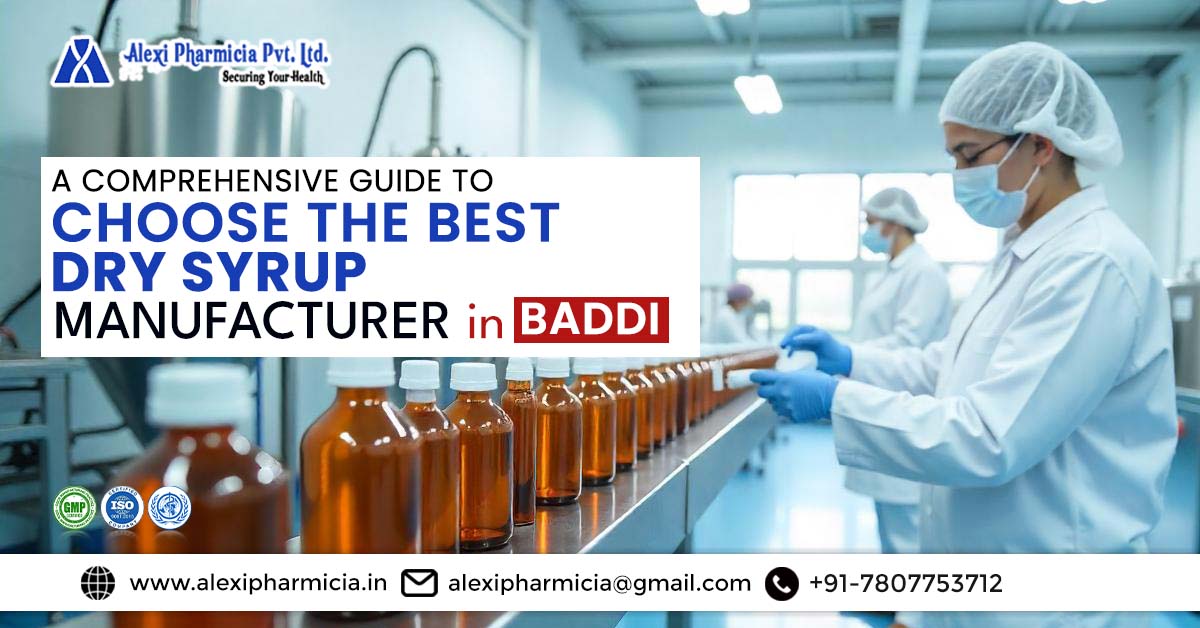
Pediatric and geriatric care frequently necessitates the use of swallowable medications that are portable and temperature stable. Hence, pharmaceutical companies rely on dry syrups—powders that gain liquid form upon reconstitution. Dry syrup manufacturers in Baddi turn this theoretical idea into a life-changing reality. They blend APIs with taste-masking ingredients, including sugars & suspending gums. Since moisture destroys effectiveness, every batch goes through low-humidity rooms and foil-lined packs. Moreover, in-house microbiology laboratories ensure zero contamination before dispatch. The Himachal hill town hosts over 350 formulation units, 38% of India’s oral suspensions dispatched every month.
Among them, Alexi Pharmicia takes the lead with lean lines, QR-coded pallets, and AI-based forecasting to eliminate stock-outs. Overall, dry syrup sales crossed ₹4,200 crore in 2024 and are going upwards. Hence, smart investors look for Baddi as a partner who combines precision with scalability.
Why Partnering with Dry Syrup Manufacturers in Baddi Fuels Fast Growth
- Strong facilities encompass closed-loop mixers, vibro-sieves, and vacuum transfer systems. Consequently, dust loss is below 0.8 %. PLC-controlled lines monitor fill weight every four seconds, thereby maintaining dose variation below ±2 %. All these allow Dry syrup manufacturers in Baddi to submit dossiers for WHO-prequalified tenders and offer bids in Africa, ASEAN, and LATAM.
- So, apart from the machinery and the approvals, the Baddi manufacturers also invest in hiring talented individuals. You’ve got QA officers, pharmacists, and microbiologists double-checking to ensure everything’s just right and the documents are in order. Most of them have real-time monitoring systems that identify any issues immediately.
- That, in turn, allows them to sidestep product recalls and build trust with consumers. Moreover, Baddi’s local laws are somewhat good for pharma companies, offering them benefits such as tax savings, electricity discounts, and advance planning permits. This means a Dry syrup manufacturing company in Baddi can focus on producing desirable products instead of getting tangled up in paperwork. And even build a competitive edge based on being more transparent.
- Doing business with a Baddi dry syrup manufacturer means having access to a setup that allows you to scale, remain compliant, and keep your business going for the long term.
Key Criteria to Select a Dry Syrup Manufacturing Company in Baddi
Audit trail depth
Thoroughly check historic MHRA, WHO-GMP, and CDSCO results. Verify that backup procedures, metadata audits, and password controls are included in data-integrity SOPs. Dry syrup manufacturing in Baddi offers zero-repeat reports. You thus prevent costly future import alerts.
Portfolio flexibility
Concentrate on the 90+ SKUs of products—antibiotics, antimalarials, probiotics, and multivitamins. This diversity cushions erosion of seasonality and offers cross-selling power. Additionally, as competition increases, first-to-file combinations benefit from larger margins.
Capacity Headroom
Choose lines at 65 % capacity. This slack absorbs festival peaks without overtime. Find twin-mixer suites that run 8,000 bottles per hour. Tight utilities provide zero unscheduled downtime.
Sustainability edge
People are noticing green footprints these days. Solar rooftops, recycling ETP, and recyclable packaging cut down CO₂ by 18%. Green plants snag CSR-driven contracts and get prime shelf space. Plus, those green savings end up giving us some price breaks.
Value-added support
Demand stability programmes, supply chain traceability, and online marketing kits. Reputable dry syrup production facility in Baddi partners package bar-coded cartons, doctor samples, and MR visual aids. Such a partnership enhances brand trust at no extra cost.
Emerging Trends Driving Dry Syrup Manufacturing in Baddi
Rising AMR demands require manufacturers to use clavulanate or beta-lactamase inhibitor fixed-dose combinations. At the same time, stevia-flavored and sugar-free formulations becomes increasingly popular among children prone to diabetes. AI predicts how local resistance patterns and current weather conditions will affect the stability of syrup. Dry syrup manufacturers in Baddi, therefore, gravitate toward desiccant-plug caps and triple-laminated pouches that preserve potency at 45 °C / 75 % RH. Single-dose sachets, however, increase 12 % CAGR, minimising carer dosing mistakes and plastic waste both. Plants incorporate IoT sensors that alert to humidity drift in real time; therefore, batch wastage is cut in half.
Exports now request QR-coded brochures linking to explainer videos in local dialects—thereby elevating adherence. In brief, the valley’s companies innovate without cease, leaving policy shifts and consumer demands far behind.
Conclusion
Baddi is India’s largest manufacturer of oral suspensions. Regulatory power, functional versatility, and environmental friendliness come together in an unsurpassed combination. Choose companies that reflect these attributes. With Dry syrup manufacturers in Baddi that reflect these attributes, your brand gains pace, is safe, and earns sustainable profit. With Alexi Pharmicia, safeguard your future and see local goals turn into national successes.
Frequently Asked Questions
Q1. How long does tech transfer take for a new dry syrup?
Six weeks would be required for pre-formulation and pilot batches. Stability data are real-time. Commercial launch would therefore be possible in twelve weeks if dossiers are available.
Q2. What is the minimum order size for custom flavors?
Most products begin at 5,000 units per SKU. Paediatric or probiotic specialty products may allow 3,000 units. Demand forecasting before volume building is aided by variable MOQs.
Q3. Are child-resistant caps compulsory for exports?
Most export countries mandate CRCs for antibiotic suspensions. Good plants stock ISO-8317-certified caps and conduct torque testing, thereby complying without additional lead time.
Q4. Can I obtain exclusive territory rights for a molecule?
Yes. Suppliers are usually the ones who conclude monopoly contracts at the state or district level. Agreements contain minimum purchase requirements and joint safety protocols. So they are also here to protect and guarantee a full return on an investment and long-term partnership.